Loading...
Loading...
A charitable project, implemented by the international non-profit organization Philips Foundation in collaboration with the EZGU AMAL charitable foundation and supported by the Ministry of Health of the Republic of Uzbekistan, has been launched in Tashkent. The initiative is aimed at improving the accessibility of diagnostic care in remote and hard-to-reach areas of the country.
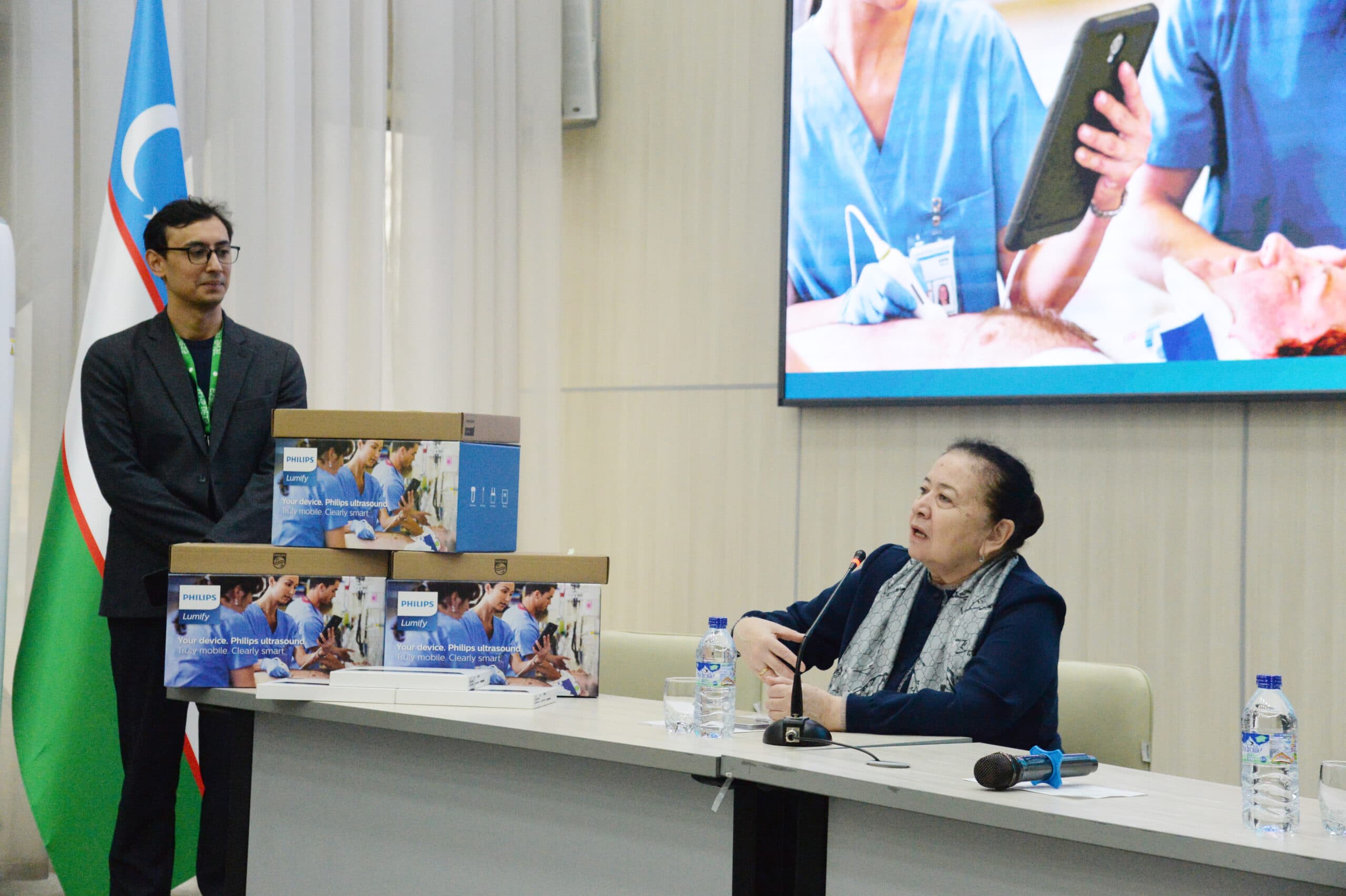
On a charitable basis, 25 mobile ultrasound systems have been dispatched to medical institutions across the Republic of Uzbekistan. This equipment will allow doctors to conduct ultrasound assessments of a patient's condition directly at the point of care—in remote regions, at accident scenes, in ambulances, at the patient's bedside, and at home. Concurrently, 24 doctors from the regions have begun training to work with these innovative portable systems.
The official launch of the project took place at the Scientific and Practical Medical Center for Pediatric Oncology, Hematology, and Clinical Immunology. The event was opened by Elmira Irkinovna Basitkhanova, Deputy Minister of Health of the Republic of Uzbekistan; Bibigul Mussakhitova, Philips Partner Engagement Lead for the CCAM region; Dilnoza Anvarovna Agzamkhodjaeva, Deputy Director for Medical Affairs and Chief Physician of the Center; and Yakhyo Fazlitdinovich Ziyaev, Chairman of the Board of Trustees of the EZGU AMAL public foundation.
The equipment distribution is planned as follows: two devices will be sent to regional medical institutions, and an additional three devices will be provided to the Scientific and Practical Medical Center for Pediatric Oncology, Hematology, and Clinical Immunology.
The provided systems are Philips Lumify: a portable ultrasound technology that transforms a compatible Android smartphone or tablet into a high-end mobile ultrasound scanner by connecting via a USB port. The compactness of this solution provides doctors with mobility and the ability to conduct diagnostics in locations lacking access to stationary equipment, where speed and promptness of care are especially crucial.